Parenting stress: What causes it, and how does it change us?
© 2022 Gwen Dewar, Ph.D., all rights reserved
 opens IMAGE file
Parenting stress damages your well-being, and it may alter the course of your kid'south development. How does stress affect parenting, and what tin we exercise most information technology?
What is "parenting stress?" What exercise psychologists mean by the term?
According to psychologists, parenting stress is the distress y'all experience when you feel you just can't cope equally a parent. The demands existence placed on you are too high. You don't have the resources to meet them (Deater-Deckard 1998; Holly et al 2019).
So what causes parenting stress?
I could give yous the blusterous-fairy answer and say, "it's caused by your state of mind." And to exist fair, this isn't altogether wrong.
There are a number of proven stress management techniques that can help cope. If you retrain your thoughts, yous can experience existent relief. That's expert news, and y'all tin can read more than nigh it in my opens in a new windowevidence-based tips for treatment parenting stress.
But still. My goodness. Allow'southward not pretend that stress originates in the parent, or that every parent faces the same set of challenges! That simply isn't true.
For example, consider the results of a meta-analyses conducted past Southward. Katherine Nelson and her colleagues (Nelson et al 2014; Nelson et al 2013).
The researchers reviewed more than one hundred published studies almost parenting, childlessness, and psychological well-being. What did they discover?
Sometimes parents study higher levels of well-being than do childless adults. Just only when their burdens are relatively light.
In particular, parents tend to be happier than the childless if their offspring have grown up and left the nest.
Parents also report greater well-being if they have high levels social support, and/or kids with no problems: Children with easy temperaments, in good physical and emotional health.
But otherwise? It's a wash, or parents tend to experience worse. And what determines the worse? Whatsoever one of these weather:
- having at least one child with a difficult temperament;
- having at least one kid with medical, emotional, or behavior problems;
- having merely low levels of social support;
- being a single parent;
- having a young kid.
Economic conditions are important also. When Jennifer Glass and her colleagues examined life in 22 Western countries, they plant marked differences in the reported well-being of parents.
Compared to the childless, parents were worse off in countries where parents receive fewer subsidies and lack family-friendly work policies.
Where were parents at the greatest disadvantage? The United states of america was the worst, with Ireland, the United Kingdom, and New Zealand ranking every bit runners-upward (Glass et al 2016).
So external factors matter. Tremendously. Tin kids stress you out? Of class they can, and it's normal to experience that way.
Tin can financial problems trigger parenting stress? Plainly.
Tin social isolation, or a inadequate support organisation? Yous bet. Exposure to hostility, crime, bigotry, pollution, congested traffic? Yes.
If it threatens your ability to provide for your children — if it makes you lot worry about your ability to go on them safe, healthy, and thriving — then it can contribute to parenting stress.
Granted, this isn't the nigh uplifting message. Information technology's more than pleasant to pretend that parenting stress is a merely a state of mind. Think the correct thoughts, and your problems will cook away.
Simply I believe it'southward more helpful to face up reality.
For ane thing, it helps us put things in perspective. A lot of parenting stress is caused past — or exacerbated by — structural features of social club. Compared with our hunter-gatherer and early agriculturalist ancestors, we lack crucial support systems for raising our kids. (Read more than in an upcoming mail service.)
Family-friendly government policies tin can help address this gap, only what if you aren't lucky plenty to live in a country with family unit-friendly policies? You're left to fight for club-wide modify, and — in the meantime — to scramble as all-time yous can.
Nevertheless — whatever else you might do — you should reassure yourself that this isn't a reflection on your worthiness or competence.
If you're feeling overwhelmed, that doesn't mean you're an inferior parent. Y'all've merely got besides much on your plate. That's of import to remember, because feelings of inadequacy, defensiveness, guilt — these feelings make parenting stress worse.
The other valuable thing about confronting reality is that helps you identify specific sources of parenting stress.
Are your stressed out considering your baby suffers from colic (excessive, inconsolable crying)? Because your toddler throws frequent tantrums? Are you going nuts because of sleep deprivation? Because y'all've got a kid with special needs? Because you're trying to work at abode while taking intendance of a young child?
Once you nada in a specific problem, you tin start working on solutions.
But showtime you lot have to admit the goal. You have to recognize that your feelings are worth fixing.
This isn't something to dismiss, to push aside while you lot soldier on. It'southward actually important that y'alldon't feel overwhelmed, fed up, or burnt out. Not simply because your well-being is intrinsically important. But also because information technology bear on your parenting — and your children.
If you demand disarming, have a look at the enquiry.
How does stress impact your parenting?
The quick respond is that stress can make us less sensitive to our children — less capable of tuning into their thoughts, feelings, and needs.
And the results can exist observed in our brains and behavior.
Brain report: Parenting stress undermines "brain-to-encephalon synchrony" between parents and children
Every bit I explain opens in a new windowelsewhere, it's normal for parents and babies to feel a kind of "mind-meld" during face-to-face social interactions.
Their brains synchronize, as if they are experiencing like thoughts and mental states. A specific surface area in a babe's encephalon "lights up," and immediately later on, the parent experiences the aforementioned thing: Increased activity in the same, specific encephalon region.
Parents experience like effects with older children, besides — especially when we're engaged in cooperative tasks (Reindl et al 2018; Miller et al 2019; Nguyen et al 2019).
More generally, encephalon-to-brain synchrony can arise between any two people — including two strangers — who attempt to collaborate on a job (Lu and Hao 2019).
And you lot don't have to talk, or fifty-fifty gaze into each other'due south eyes. Inquiry shows that "brain-to-brain synchrony" can happen when parents and children aren't communicating one-on-one, but instead just sharing a moment.
Unless the parents are struggling with lots of stress.
Recently, Atiqah Azhari and her colleagues explored the phenomenon in an experiment on 31 toddlers and their mothers.
Every bit y'all can see in the illustration beneath, the kids sat on their mothers' laps while both watched video clips on a laptop. In addition, both parties wore electrode caps that recorded their encephalon activeness (via functional nigh-infrared spectroscopy). This allowed researchers to track brain responses in real fourth dimension.
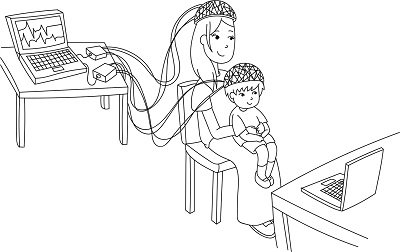
The mother-child duos saw several dissimilar animated clips, each depicting different characters and different emotions. And every bit they did, they experienced brain-to-encephalon synchrony in a region linked with emotional regulation and social reasoning (the medial left cluster of the prefrontal cortex).
But the caste of encephalon-to-brain synchrony depended on parenting stress.
Before the experiment began, the researchers had given each female parent a questionnaire to fill out. This questionnaire asked parents to charge per unit their understanding with statements like these:
- "Since having my child I have been unable to try new and unlike things."
- "My kid is non able to exercise equally much as I expected."
- "My child generally wakes up in a bad mood."
Mothers who tended to agree strongly with such statements were judged to have more parenting stress, and these same mothers were less "in tune" during the joint viewing feel: They showed less brain-to-brain synchrony with their children.
What does it mean? We can't know for certain. Peradventure the stressed mothers were likewise distracted to go "on the same wavelength." They didn't process the emotional content that their children were viewing, then their brain activity didn't friction match upward.
Or perhaps the children themselves were less emotionally responsive, less savvy to what was going on in the cartoon storylines. For reasons of their own, the toddlers of stressed-out mothers might have been less aware of what was transpiring on the screen, making their emotional states harder for mothers to track.
But either way, the results suggest that the mothers and children weren't sharing the same emotional reactions as they watched the cartoon content.
Parents reporting high levels of parenting stress were less attuned to their toddlers' inner reactions.
So that'south a peak at what'due south happening in the brain. What happens outwardly? How does parenting stress touch intendance-giving?

Inquiry confirms our everyday intuitions. When parents experience stressed out, they're at greater risk for two types of maladaptive response. They tend either to
- overreact to their children (bravado a fuse, getting upset to easily), or
- become withdrawn and emotionally unresponsive.
For example, consider a report by Melissa Sturge-Apple tree and her colleagues.
The researchers recruited more than 150 mothers with young toddlers, and each family received the same treatment.
Outset, the toddler was left alone in an unfamiliar room with a complete stranger. After a few minutes, the toddler was reunited with his or her mother.
[Note: This is a standard testing procedure chosen the "Strange Situation." You tin can read more than about the Strange State of affairs in opens in a new windowthis Parenting Science article, but the important betoken here is that it's stressful.]
Second, the mother and child were taken to a playroom full of toys. Earlier leaving them together, a enquiry assistant instructed the female parent to play with her child "as she normally would at home."
Throughout the experiment, researchers observed the behavior of mothers and children. They also screened the mothers for symptoms of depression, and monitored maternal stress physiology with a wireless electrocardiogram system.
And the results?
Equally you lot might imagine, the toddlers weren't calm and happy during the Strange Situation. They experienced distress, and their mothers reacted. But mothers didn't all react the same manner. Not during the Strange Situation, and non during the follow-up in the room full of toys.
Some mothers followed a low-stress trajectory. They did get ruffled when their children were upset during the Strange Situation. But they bounced dorsum quickly, and they responded to their children's distress in a calm, sensitive style. The best parenting on display.
Other mothers responded differently.
In that location was a group that experienced loftier levels of physiological stress during the Strange State of affairs. They were distressed because their children were distressed, and they weren't able to bounce dorsum quickly.
When their kids acted out, these mothers were more likely to answer in ways that were harsh, or hostile. They were besides more likely to get bossy during gratuitous play — condign overly intrusive and directive.
And at that place was a grouping of mothers — often suffering from depression — who seemed burnt-out.
These parents showed less sensitivity to their children, and, compared with low-stress mothers, they were more intrusive and snobby. Only their about distinctive characteristic was emotional. Of all the parents, they were the to the lowest degree emotionally engaged.
So it appears that stress can make parents less sensitive, and more harsh, snobby, or emotionally withdrawn. What, then, are the consequences for kids?
How does parenting stress affect children?

Start, the obvious: We know that stress is socially contagious. Even if we don't intend information technology, our stressed-out emotions tend to "infect" those around us.
Kids don't have to be quondam enough to empathise what'south going on. Every bit I explain in another Parenting Scientific discipline commodity, opens in a new windoweven babies can sense when you're stressed.
And, as I note opens in a new windowhere, enquiry indicates that babies experience spikes of cortisol when they overhear their parents fighting.
But what about the long-term? Can parenting stress cause harm to children?
It's tricky, answering this question. We can't comport controlled experiments. We can't randomly assign some children to be raised by stressed-out parents. That would be unethical.
So developmental research on humans is observational, not experimental. And when we notice links between parenting stress and long-term outcomes, we can't be sure about the causation.
Did the parent's stress cause issues in the kid? Or was the parent'southward stress caused by her child's problems?
Information technology'south hard to know, but the timing is suggestive.
When researchers have tracked families over the grade of several years, they've found evidence for bidirectional furnishings. Kid behavior problems tin boost parenting stress, and parenting stress can escalate kid behavior problems (Neece et al 2014; Baker et al 2003).
And and then there's the research on nonhuman animals.
Experiments on rodents and monkeys: Chronic exposure to parental stress can change the manner a baby develops

Pressure a mother rat — by making her think a hostile male lurks nearby — and her babies volition grow more than slowly, eventually condign adults prone to anxiety and stress-related disease (Nephew and Bridges 2011; Moles et al 2008).
Overtax a mother monkey — past putting her on an erratic foraging schedule — and her babies will testify less interest in play and exploration. As adults, they will be less social, and they may end up with smaller brain volume in several regions of the cerebral cortex and hippocampus (Meyer and Hamil 2014).
How do these developmental changes work? One avenue is epigenetic — a process by which ecology factors can turn genes "on" or "off."
It'south a process that's been documented in rats, and research suggest it takes place in humans too.
In one written report, teens were more probable to show evidence of epigenetic change if — during infancy and early on childhood — their parents had experienced lots of stress (Essex et al 2011).
We also know that sensitive, responsive care-giving has long-term developmental benefits. And then to the degree that parenting stress renders united states less sensitive, our kids will miss out.
As I note in other manufactures, studies signal that emotional warmth and nurturing touch on can counteract the furnishings of toxic stress.
Sensitive, responsive care opens in a new windowcan boost a kid'southward oxytocin levels, reverse detrimental epigenetic changes, and take a positive impact on a kid's health and development (Meaney 2001; Sharp et al 2012; Luby et al 2013).
It isn't hard to imagine how parenting stress could disrupt these processes. If you're stressed– feeling hassled and worn-out — you might make fewer attempts to show affection to your kid. Yous'll take missed opportunities to improve family relationships and help kids bounce back.
Information technology seems, then, that parenting stress tin pb to a cascade of problem. What can you do virtually it?
Feeling guilty or worried isn't the reply
Anticipating bug can be a good thing when it allows you to plan ahead and avoid trouble. Guilt can motivate you to avoid repeating mistakes (Tangney et al 2007).
Merely these feelings become maladaptive when you overreact, concur yourself to unrealistic standards, or get distracted from finding practical solutions.
For conscientious parents, worry and guilt may exist a major cause of stress.
Then, aside from the social and economic support I mentioned at the commencement of this article, what parents really need is information. Information that helps us feel better — more competent, secure, empowered, and inspired.
For instance, if y'all have a choked baby, you need to notice practical means to keep your baby calm and emotionally healthy. Come across my Parenting Science guide to coping with a stressed-out infant.
If you take a disruptive or aggressive child, y'all demand effective strategies for steering your kid in a more cooperative management. See opens in a new windowthese Parenting Science tips.
If y'all have an adolescent who seems to resist every request, you need to empathize what kids believe about the legitimacy of authority. (Read more than opens in a new windowhere).
And yes, yous should also take direct steps to better your emotional well-being. For a self-assist guide to stress management, run into these opens in a new windowParenting Scientific discipline tips coping with parenting stress.
If you've recently had a baby, have stock of your mental health. Postpartum stress is a common problem, and then, too, is postpartum depression. For more data, see my article nigh opens in a new windowpostpartum stress, and this Parenting Scientific discipline guide to postpartum depression symptoms.
More reading
Is the electric current public health crisis stressing you lot out? Here are my thoughts about the changes nosotros're living through, and how to cope.
References: Parenting stress: Why information technology matters
Azhari A, Leck WQ, Gabrieli Grand, Bizzego A, Rigo P, Setoh P, Bornstein MH, Esposito G. 2019. Parenting Stress Undermines Mother-Kid Brain-to-Brain Synchrony: A Hyperscanning Study. Sci Rep. 69(i):11407.
Baker BL, McIntyre LL, Blacher J, Crnic K, Edelbrock C, Low C. 2003. Pre-school children with and without developmental delay: behaviour problems and parenting stress over time. J Intellect Disabil Res. 47(Pt 4-5):217-30.
Deater-Deckard K. 1998. Parenting stress and child adjustment: Some old hypotheses and new questions. Clinical Psychology: Science and Exercise. 5:314–332.
Essex MJ, Boyce WT, Hertzman C, Lam LL, Armstrong JM, Neumann SM, Kobor MS.2013. Epigenetic vestiges of early developmental adversity: childhood stress exposure and Deoxyribonucleic acid methylation in adolescence. Child Dev. 84(1):58-75.
Glass J, Simon RW, Andersson MA. 2016. Parenthood and Happiness: Effects of Work-Family unit Reconciliation Policies in 22 OECD Countries. AJS. 122(3):886-929.
Graham AM, Fisher PA, and Pfeifer JH. 2012. What sleeping babies hear: a functional MRI study of interparental conflict and infants' emotion processing. Psychological Scientific discipline 24(5):782-789.
Holly LE, Fenley AR, Kritikos TK, Merson RA, Abidin RR, Langer DA. 2019. Evidence-Base Update for Parenting Stress Measures in Clinical Samples. J Clin Child Adolesc Psychol. 48(five):685-705.
Luby J, Belden A, Botteron K, Marrus N, Harms MP, Babb C, Nishino T, Barch D. 2013. The effects of poverty on childhood brain development: the mediating effect of caregiving and stressful life events. JAMA Pediatr. 167(12):1135-42.
Meaney MJ. 2001. Maternal care, factor expression, and the manual of individual differences in stress reactivity across generations. Annu Rev Neurosci. 24:1161-92. benefits.
Meyer JS and Hamel AF. 2014. Models of stress in nonhuman primates and their relevance for human psychopathology and endocrine dysfunction. ILAR J. 55(2):347-60.
Mikolajczak Thousand, Gross J and Roskam I. 2019. Parental Exhaustion: What Is Information technology, and Why Does It Thing? Clinical Psychological Science. 10.1177/2167702619858430.
Miller JG, Vrtička P, Cui 10, Shrestha Due south, Hosseini SMH, Baker JM, and Reiss AL. 2019. Inter-encephalon synchrony in mother-child dyads during cooperation: An fNIRS hyperscanning written report. Neuropsychologia 124:117-124.
Moles A, Sarli C, Bartolomucci A, and D'Amato FR. 2008. Interaction with stressed mothers affects corticosterone levels in pups after reunion and impairs the response to dexamethasone in adult mice. Psychoneuroendocrinology. 33(4):462-70.
Neece CL, Green SA, Bakery BL. 2012. Parenting stress and kid behavior problems: a transactional relationship across time. Am J Intellect Dev Disabil. 117(1):48-66.
Neece C and Baker B. 2008. Predicting maternal parenting stress in heart childhood: the roles of child intellectual status, behaviour issues and social skills. J Intellect Disabil Res. 52(12):1114-28
Nelson SK, Kushlev K, and Lyubomirsky S. 2014. The pains and pleasures of parenting: When, why, and how is parenthood associated with more or less well-being? Psychological Bulletin 140: 846-895.
Nelson SK, Kushlev K, English language T, Dunn EW, and Lyubomirsky S. 2013. In defense of parenthood: Children are associated with more joy than misery. Psychological Science 24: 3-10.
Nephew BC and Bridges RS. 2011. Effects of chronic social stress during lactation on maternal behavior and growth in rats. Stress. 14(6):677-84.
Nguyen T, Schleihauf H, Kayhan E, Matthes D, Vrtička P, Hoehl Southward. 2020. The effects of interaction quality on neural synchrony during female parent-child problem solving. Cortex. 124:235-249.
Reindl Five, Gerloff C, Scharke W, and Konrad K. 2018. Brain-to-encephalon synchrony in parent-kid dyads and the human relationship with emotion regulation revealed past fNIRS-based hyperscanning. Neuroimage. 178:493-502.
Sturge-Apple ML, Skibo MA, Rogosch FA, Ignjatovic J and Heinzelman West. 2011. The bear upon of allostatic load on maternal sympathovagal functioning in stressful child contexts: Implications for maladaptive parenting. Development and Psychopathology 23: 831-844.
Towe-Goodman NR, Stifter CA, Mills-Koonce WR, Granger DA and Family Life Projection Cardinal Investigators. 2012. Interparental aggression and infant patterns of adrenocortical and behavioral stress responses. Dev Psychobiol. 54(7):685-99.
Waters SF, West Boob tube, Mendes WB. 2014. Stress contagion: physiological covariation between mothers and infants. Psychol Sci. 25(4):934-42.
Content of "Parenting stress" last modified iv/2020.
Championship epitome of woman holding her head, eyes closed, by David Garrison / pexels
Image of mother with infant by globalmoments / istock
Image of father and stubborn child by fizbes / istock
Image of female parent and babe macaque: Asman and Lenoble / wikimedia
templetonmues1951.blogspot.com
Source: https://parentingscience.com/parenting-stress/
0 Response to "Parenting stress: What causes it, and how does it change us?"
Post a Comment